A small bakery in Singapore once advertised itself as “the cheapest cakes in town.” Sales rose for a while, but soon customers stopped returning. The team realised they were attracting bargain hunters who didn’t care about the brand story, quality, or consistency. When they tried to raise prices, they lost their audience. Their USP had become a trap, not a strength.
The lesson: a USP is not just a catchy statement. If it’s the wrong USP—one that doesn’t belong to your business or doesn’t fit your audience—it can damage your brand, confuse customers, and waste your marketing budget.
This guide helps you uncover your true X-factor and avoid the pitfalls of a misaligned USP.
Why the Right USP Matters for Branding
A strong USP helps your brand stand out, but the wrong one can:
- Attract the wrong customers
- Make your brand appear inconsistent or cheap
- Reduce trust and long-term loyalty
- Create a “brand identity gap” between what you promise and what you deliver
Stats that prove it:
- 61% of consumers are willing to pay more for a better brand experience, not just a lower price. (PWC)
- 86% of consumers will pay more for a better customer experience, meaning the perceived value of your brand matters more than price alone. (PWC)
- 60–70% of buying decisions are based on emotions, not features. (Harvard Business School)
These stats show that your USP should be emotionally relevant and aligned with your brand promise—not just a functional feature.
Finding Your Business’s Unique Selling Point:
This article is specially catered to our Digital Marketing course students. So here’s an example of a simple homework spreadsheet for identifying Unique Selling Point in your business:
| Task | Description |
|---|---|
| Step 1: Define your target audience | Identify your ideal customer and create a detailed description of their demographic, psychographic, and behavioral characteristics. |
| Step 2: Analyze your competition | Conduct a thorough analysis of your competitors’ products, services, marketing strategies, and unique selling points. |
| Step 3: Identify your strengths | Determine what makes your business unique, including your strengths, expertise, and resources. |
| Step 4: Determine your value proposition | Develop a clear statement that communicates the unique value that your business provides to your target audience. |
| Step 5: Test your unique selling point | Get feedback from your target audience to see if your value proposition resonates with them and adjust as necessary. |
For each task in the above 5 steps, a Business owner should provide a detailed response based on their own business. This exercise will help you identify your unique selling point and better position your business in the market.
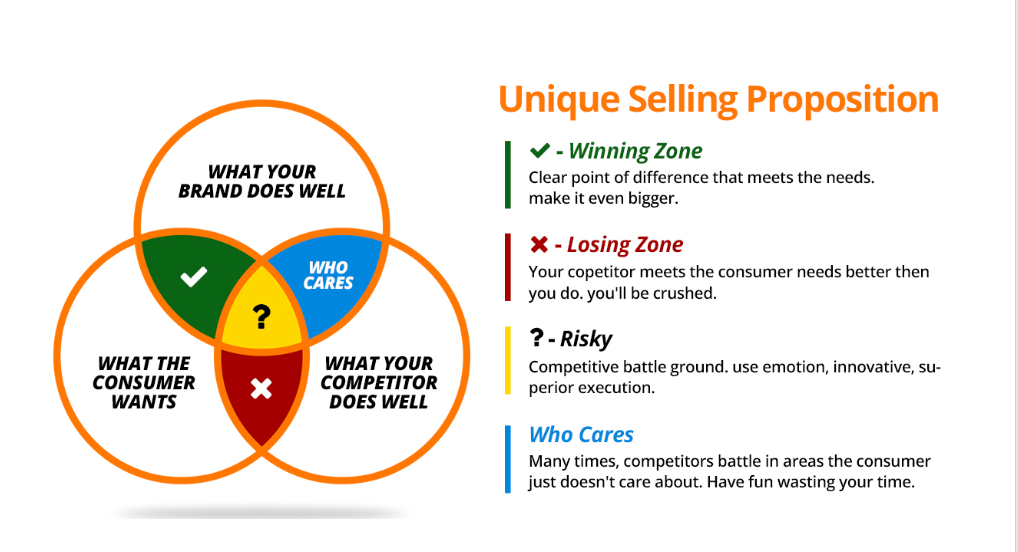
BONUS: Key Questions to Find Your True USP (and Avoid the Wrong One)
1. What is the real problem your product solves?
A USP should address a clear pain point. If your USP focuses on price, you may attract customers who will leave when prices change.
2. What do customers value most about your brand?
Ask existing customers: “Why did you choose us?” Their answers reveal the real USP.
3. What makes your process or product unique (not just different)?
Being different is not enough. Your USP must be meaningful and defensible.
4. What do competitors claim as their USP?
If your USP sounds identical to others, it becomes noise. You need a USP that can be verified and experienced.
5. What do you want your brand to be known for in 3 years?
If your USP is temporary or trend-based, it may hurt long-term branding.
6. Does your USP match your pricing strategy?
A low-price USP forces you to stay low-cost. If you want premium positioning, price-based USP can be damaging.
7. Can your team consistently deliver the promise?
A USP that cannot be delivered will damage your reputation and brand trust.
Common “Wrong USP” Examples (and Why They Fail)
Wrong USP #1: “Cheapest”
- Attracts bargain hunters
- Limits future pricing
- Reduces perceived value
Wrong USP #2: “Fastest Delivery” (when your logistics can’t sustain it)
- Leads to broken promises
- Damages trust when delays happen
Wrong USP #3: “Best Quality” (without proof)
- Sounds like every other brand
- Needs evidence (reviews, awards, certifications)
Wrong USP #4: “We do everything”
- Confuses customers
- Weakens brand clarity
How the Right USP Strengthens Branding
A correct USP helps you:
- Build consistent visuals and messaging
- Attract customers who stay longer
- Improve conversion and loyalty
- Create stronger brand recognition
In short, the right USP becomes the foundation of your brand identity.
How Lepakcreator Helps Business Owners with USP and Branding
At Lepakcreator, we help business owners who struggle with online marketing to:
- Discover the real USP through customer insights and market research
- Translate the USP into brand messaging and visual identity
- Create a consistent brand story across website, social media, and ads
- Avoid the “wrong USP trap” that attracts the wrong audience
We focus on clarity, consistency, and strategy so your brand becomes recognisable and trusted.
People also Search online:
Q: What is a USP and why does it matter? A USP (Unique Selling Point) is what makes your brand different and valuable. It matters because it shapes customer perception and influences buying decisions.
Q: How do I know if my USP is wrong? Signs include: inconsistent brand message, low customer loyalty, price sensitivity, or customer confusion.
Q: How can SMEs in Singapore find a strong USP? Use customer interviews, competitor research, and local market trends to discover what your audience values most.
Q: What questions should I ask to find my business’s USP? Ask about customer pain points, brand strengths, competitor gaps, and what customers would miss if you disappeared.
Q: Can a USP be based on a new category or market need? Yes. A blue ocean USP creates a new market space by solving an unmet need or combining features uniquely.
Conclusion
A USP is not just a marketing slogan—it is the foundation of your brand identity. Choosing the wrong USP can misalign your brand, attract the wrong customers, and weaken your long-term growth. The right USP, however, creates clarity, trust, and stronger brand loyalty.
What will you change in your USP today to make your brand stronger and more aligned with your true audience?
(Image Credits: Charmain Tan)
👉🏻 Look out for the latest Marketing & related Tips @lepakcreator Telegram Channel!
Since you’re here, why not Read: